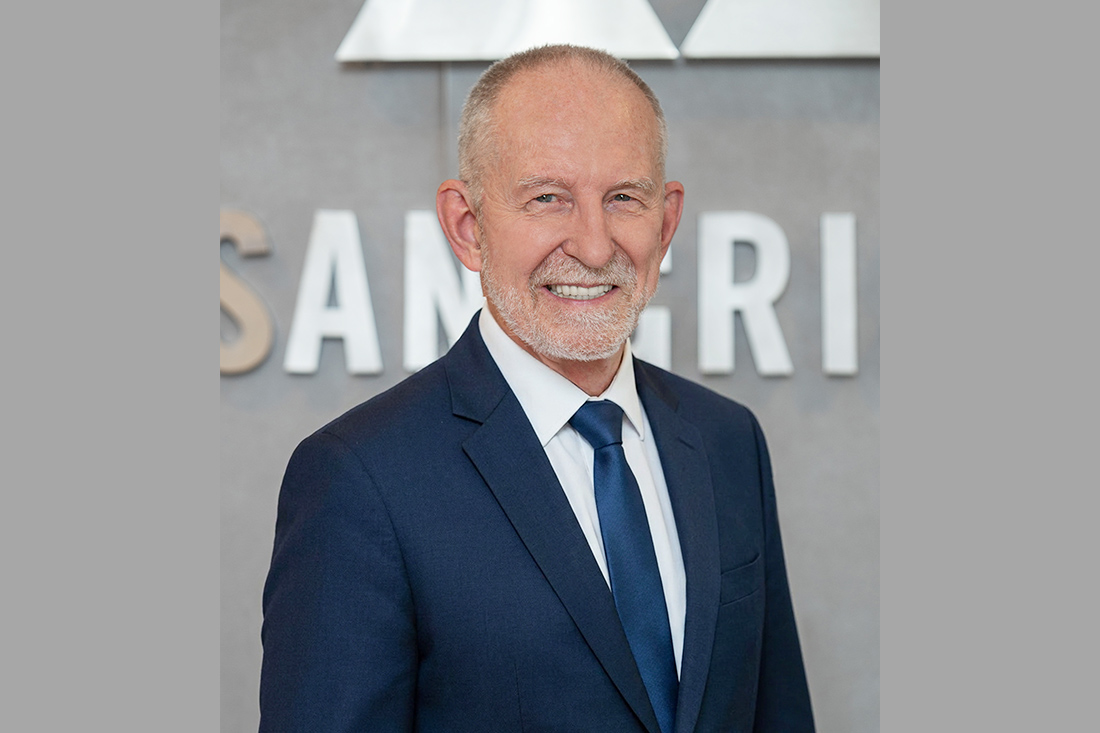
22 Sep Interview with Mr. Joseph David Assels, Executive Chairman of Minera San Cristóbal, Bolivia
Mining continues to be one of the fundamental pillars of the Bolivian economy, world-class companies play a key role in generating value and exports. How does Minera San Cristóbal evaluate its contribution to Bolivia’s economic development and what have been some of the company’s main achievements in recent years?
We started with the vision — and this was after Sumitomo Corporation took over from Apex Silver Mines after Apex went bankrupt. We started with the vision that we wanted to become a world-class mining company. The mission was to develop a model mining operation through safe operations, through low cost, with innovative technology, with social commitment and respect for the environment. This was all-inclusive and it had to create value for the state and the stakeholders — not just the shareholders of the company, but all the stakeholders as well: the employees, the region we operate in, the company itself and the country.
To do that, we developed our core values. Our core values were trust, integrity, teamwork, honesty, professionalism and one of my favorites: continuous improvement. We looked at everything where we didn’t meet a target as an opportunity to improve. We set up processes where, when something didn’t meet a target, we would review the process and ask ourselves, “Okay, how do we make this process better?” It wasn’t a matter of assigning blame when something went wrong. Instead, we said: this is an opportunity to improve. Mutual respect was part of it. Transparency, commitment to the environment and safety were all part of it as well. But these were all words and they had different interpretations for different people — communities, unions, workers, staff, executives. We all saw the same words, but interpreted them differently.
We had to develop workshops on communication and on what these concepts actually meant, so that everyone would be on the same page. Mutual respect was often a challenge, because for some people it meant we respect each other and can speak freely, while for others it meant that you had to agree with them. Those were things we had to overcome and they became learning experiences that ultimately made us better. That was a major focus during our first few years and it really wasn’t resolved until around 2010. So we spent about three years working through this process of understanding each other. All businesses are based on relationships and relationships are based on trust. You don’t have trust unless you have open communication and understand each other.
Could you elaborate on the key innovations and digital solutions that Minera San Cristóbal is implementing to optimize the production of zinc, lead and silver while enhancing efficiency, cost management and overall productivity?
First of all, an open-pit mine has a lot more technology and a lot more large equipment than underground mines. From the very first day of our operation, we were probably the biggest producer in the country. When you look at the productivity of an open-pit mine versus an underground mine, someone in an underground operation might produce one to one-and-a-half tons per day, whereas with our workforce — which is currently around 1,380 people — our productivity ranges somewhere around 3,500 to 4,000 tons per person per day. So the ratio is completely different when you measure productivity. All of our technology for processing low-grade minerals depended on large-scale operations. We needed large mills, large flotation tanks and to manage all of that we had to implement technology capable of tracking everything and responding quickly to any problems.
We process multiple types of minerals and when different minerals enter the plant they create different reactions. We had to be able to react quickly to changes in clay content. More clay means more lime, for example. All of these adjustments had to be made continuously and very quickly. After we started operations, we introduced even more technology. We developed a long list of innovations internally, with our own people. We started an expert system using cameras that monitor the material coming in on the conveyor belts. That allows us to know what is coming before it reaches the plant. The cameras can interpret what actions need to be taken and the computers automatically adjust the chemical composition, the type of reagents and the quantity of water, for example. We also implemented sound technology on our mills so the mills could detect when they were operating at maximum efficiency. This system controls water usage and reduces the speed at which the mills need to operate, which in turn reduces electricity consumption.
The result over time was significant. When we first started, we were consuming approximately 45,000 cubic meters of water per day. Today we are operating below 20,000 cubic meters per day. So we reduced our water consumption by more than 60 percent, while at the same time increasing production by 30 percent. To achieve this reduction in water usage, we even developed and patented our own method for recovering water at the thickeners instead of sending it to the tailings system. That reduced electricity costs because there was less pumping involved and it reduced the amount of fresh water we needed. All of these technologies were introduced by our own people. We did not rely on outside consultants.
When we saw our grades decreasing, we knew we would have to increase production to compensate. Our mine originally started at 40,000 tons per day and we increased production to 52,000 tons per day, which is huge for Bolivia — and frankly, significant anywhere in the world. That represents a 30 percent increase in production while simultaneously reducing electricity consumption by 15 percent and water consumption by 60 percent. To increase production, one of the major U.S. engineering companies gave us a proposal valued at approximately 175 to 180 million dollars over a two-and-a-half-year period. Instead, we decided to do it ourselves. Using our own people in each area, we started at the beginning of the process — crushing — and then worked through the conveyor belts, feeders, grinding and flotation systems. Each department analyzed how to debottleneck operations, reduce problems and increase production. Everything was done internally. They analyzed what we were doing, what the equipment was capable of and what needed to be changed to improve performance. In the same two-and-a-half-year period, we accomplished for $30 million what the engineering company would have charged $180 million to do.
Sustainability has become a defining priority for the global mining sector, especially with increasing scrutiny from stakeholders worldwide. How does Minera San Cristóbal implement a proactive and preventive environmental philosophy in its operations and what measurable outcomes have you achieved in terms of environmental management, resource efficiency and emissions reduction?
I’ll go back to the construction period. I think about five percent of the participation in the project came from the World Bank and the World Bank had a representative here, Ian Thompson. I made a commitment to him when we were finishing the mine that we would not allow anything to leave the property. Period. No exceptions, no qualifications. We had set up various dams along the rivers so that if anything ever escaped, we would capture it. If it passed the first dam, we would catch it at the second and then the third. In total, we had seven dams. The idea was to guarantee that nothing containing contaminants would leave the property. We did have one event where there was a failure in a valve. It happened at night and about 10,000 cubic meters of tailings entered the local river. We found it the next morning, corrected the problem immediately and had everything cleaned up within three days. By the time the inspection was carried out to assess the damage, there was nothing left to be found. That was the only reportable incident we have ever had.
In 20 years of operation, that was the one significant incident and we cleaned it up before it was even inspected. Our general manager at the time wanted to prove a point, so he went to the river with the community leaders, took a glass of water directly from the river, drank it and said, I’m not worried. Everything’s fine. That was the level of commitment.
To carry out that cleanup, we pulled all the equipment off the mine, so we sacrificed production. I moved mining equipment down into the river and it became an all-hands-on-deck effort where everybody participated in fixing the problem. That is just one anecdote about one event. The everyday work that goes into preventing incidents is what really prevents the major problems. We conduct training with all of our staff. It’s not just that we have an environmental department and they know everything — no. The role of the environmental department is to communicate to everybody else what they can do to contribute and how they are part of the system. This goes back to teamwork, which is another one of our core values. It helps when all of us understand what the other person has to do, what their contribution is and how our own work affects theirs. It’s not just a matter of saying, “This is my job and I’m going to do it.”
Building strong and lasting relationships with communities is essential for the long-term success and social license of mining projects. How does Minera San Cristóbal engage with the communities of San Cristóbal, Culpina K, Vila Vila and Río Grande to foster inclusive growth, social development and shared value creation?
Again, this was a work in progress. We had to learn what it was that the communities actually wanted. At first, we came in with preconceived ideas about the kinds of projects we believed would be sustainable. When we introduced those ideas to the communities, they basically responded, “Okay, that’s fine.” But the whole idea behind those projects was that eventually the communities themselves would take them over. The problem was that, because the projects were not their own ideas and not their own priorities, they did not have much interest in maintaining them. So in the end, those projects did not work.
Over time, we learned to listen to what their real priorities were. In the case of all these communities, their priorities were tourism, generating some cash income, maintaining their traditional lifestyle with their animals — mainly llamas — and continuing their quinoa production. Those became the three pillars of their vision for the future. As the mine developed, their vision also began to expand and they started seeing other opportunities as well. Their local economy was based on each community competing individually to sell quinoa, all operating on a very small scale. We recognized an opportunity to bring them together through what we called the Consejo Consultivo. We brought together the four communities — including Río Grande — to work collectively on defining what they actually wanted. They began holding quarterly meetings organized into working tables focused on different areas such as education, healthcare, livestock, quinoa production and several other topics. Each community had representatives participating and we showed them that there is strength in numbers. By working together, they could develop projects and attract support from NGOs, the Canadian government and other organizations.
At the same time, we made it clear that they also had to contribute themselves. We knew they were receiving royalties and while we were willing to contribute funding, we tried to limit our participation to around 25 or 30 percent.. The rest had to come from them and they had to manage the projects themselves. We could help with engineering, contracting and connecting them with third parties that could support them, but ultimately the projects had to belong to the communities. The Consejo Consultivo was very successful in getting the communities to work together instead of fighting with one another. It unified the communities. In fact, sometimes that unity even worked against us during strikes — but it also meant they were working together with a shared vision. The communities would come up with projects that we could help finance. They did not necessarily know how to promote those projects to third parties, so we helped them with that process as well. But the essential point was that these were their projects.
That is what made them more sustainable, because sustainability is not about communities constantly coming to us whenever they need help. Simply giving people money and solving all of their problems is not sustainable. That’s just buying them off. Helping communities develop their own projects, promote them, finance them and maintain them themselves — that was the real key to sustainability.
Human capital is a critical asset in highly technical and complex operations such as mining. What strategies has Minera San Cristóbal implemented to attract, develop and retain top talent, while also ensuring a strong culture of safety, well-being and continuous professional development across its workforce?
Let me focus on safety. We started out with a fairly good safety record because we used international standards from the beginning. The main contractor for the construction was Bechtel Corporation. Initially, they operated through their San Francisco office and later through their Chilean office, but most of the superintendents were North American. They also brought in contractors from Peru because Bolivia did not yet have the skilled labor needed to build the kind of massive plant we were constructing. A lot of workers came from the Peruvian company Graña y Montero to carry out much of the work. This created our first major conflict with the communities because they had been led to believe that all of those jobs would go to local residents. But the reality was that they did not yet have the necessary skills, so we experienced frequent conflicts with the communities. Still, the standards we adopted came from the United States, Chile and Peru through the contractors we were working with, so they were international standards.
When we transitioned from construction into operations, one of my responsibilities at the end of construction was helping the general manager decide which construction workers could transition into becoming operators. Again, there was essentially no local experience with this kind of operation in the country. People often expected that after six weeks of training they could immediately become managers, but becoming a qualified operator takes ten years. We had to go through all of those struggles around expectations, understanding and recognizing people’s limitations. Fortunately, my team and I were very patient. We understood from the beginning that this process was not going to be easy and that it would take time. We invested heavily in training. We brought in people from the United States and Australia to train local workers and we went through a full year of training just to give people the basic technical foundations.
Technical training was only one part of it: the other challenge was teaching people how to integrate into an organization. This is where I give a lot of credit to the people from Sumitomo Metal Mining, who introduced us to the concept of a business management model. That model was built around leadership, organizational development, systems and structures. It was fundamentally based on values-driven leadership. The idea was that leaders had to work closely with workers — not only teaching them what their tasks were, but also helping them understand the processes needed to achieve results. Instead of overwhelming employees with large manuals, we created process maps. The maps showed: when you do this, what is the next step? And after that? And how do different departments connect and interact with each other? Everything was linked through these process maps. For example, if we planned to produce 10,000 tons in a day but only achieved 8,000, instead of treating that as a failure, we asked: what went wrong? Maybe the plant didn’t receive enough material from the mine. That immediately became an opportunity for improvement. This was how we started teaching people that problems should not simply be labeled as failures. They are opportunities to improve. We began implementing these systems around 2007, but it was really by 2009 that people fully understood and adopted them. It took about two years to properly establish the system.
As part of organizational development, we also had to clearly define people’s roles. The executive team focused on strategic development. Team leaders focused on their specific subject areas. Middle managers acted as the bridge between strategy and implementation. The superintendents and field personnel were responsible for tactical implementation on the ground. Meanwhile, executives and managers focused on long-term strategy: what risks are we going to face in five years? How do we mitigate those risks? Managers then had to translate those strategies into concrete plans and pass them down to the superintendents, who developed tactical plans for the following year. All of that was then communicated to the workers, so every employee understood their role within the overall process.
In the end, the system was really about empowerment. As managers, we often come in believing we are supposed to know everything. But in reality, we have to trust people. — one of our core values. We have to trust the people responsible for tactical implementation and believe they can succeed. We understand that if they achieve 80 percent of the goal, that is already a success. Then the question becomes: what are we going to do about the remaining 20 percent? That becomes the challenge for the following year.
Over the years the mining sector has also been facing growing expectations in terms of transparency, governance and corporate social responsibility. How does Minera San Cristóbal strike a balance between delivering sustained value to its shareholders while also fulfilling its broader social and environmental commitments?
When you talk about finding a balance, it almost sounds like you’re sacrificing one thing to promote the other. We don’t look at it that way. We look at the whole business as being integral. We don’t make a profit if we don’t take care of these other things. We don’t have a business if we aren’t focused on sustainable activities. I’ve worked on projects where you have to shut down operations after a serious accident. I once had to calculate for Newmont, after a series of accidents in one week, what the actual cost was. I looked at the shutdown time, how much production was lost and what the long-term effects on morale were. A lot of things went into it.
Safety in particular — and sustainability as well — have to be part of the whole package. It’s not like I’m balancing safety versus production. I don’t have production unless I have maximum safety. My maximum production happens when I have the lowest risk. How do I get the lowest risk? By having maximum safety. When we first started, we had contractors and local contractors and then we had our own employees. Our employee safety performance was very good. Our contractors, statistically, were four times worse. We analyzed what was wrong and a lot of it was simply expectations around paperwork and them not really understanding what it was we wanted to achieve. We track incident rates based on how many hours people work. The contractors were way up with their incidents, while we were much lower. Over time, starting in 2010, our rates came down all the way to zero incidents as of 2026 and if you look at the contractors, they started very high and have also come down. We dedicated two weeks to training their people on critical activities which was at our expense, but we got immediate results. Now the contractors are pretty much at the same level as us.
Global demand for critical minerals is accelerating, driven by the energy transition, electrification and industrial transformation in general. Within this context, Minera San Cristóbal is uniquely positioned to play a key role in supplying essential resources to international markets. In this sense, can you share the company’s strategic vision for the coming years, particularly regarding its relationship with the U.S. market?
Right from the beginning we have been competitive. When you look at the markets, the question is really: who do we sell to? When the company belonged to Sumitomo, we basically sold our produce to Sumitomo and they handled distribution to different international markets. We ourselves were not directly involved in the marketing side. At that time, Sumitomo was sending material mainly to Australia, Japan and especially Korea. There was nothing going to China at that point. Some material was also sent to Europe and only very rarely to the United States.
Then, in 2023, we were purchased by a company that adopted our name, San Cristóbal Mining Inc., and they took over the marketing side of the business. Currently, exports are still focused mainly on Europe and Asia. Could exports eventually go to the United States? Possibly, but that is not really my area of expertise. As relations and developments between the United States and Bolivia continue evolving, I am sure some of those developments may eventually result in minerals being directed toward the U.S. market. At the same time, the United States is in the process of building refineries capable of receiving and processing these materials. Up until now, there simply have not been many refineries available for us to send material to. What I can say is that the market remains flexible and depends heavily on factors such as where the refineries are located and how much it costs to process the material. Those treatment and processing costs vary significantly from one jurisdiction to another and they are a major factor affecting our final income.
What message would you like to convey to global investors, industry stakeholders and readers about Bolivia’s mining potential and Minera San Cristóbal’s role as a leading contributor to the country’s economic development and sustainable growth?
The opportunities in Bolivia have always been there. The minerals are here and there has not been enough exploration or mining development. The fact that we are the only open-pit mine in the country tells you that there is much more opportunity for mining in Bolivia. Bolivia is probably one of the last frontiers in South America for massive exploration and development.
The recent change in government is also giving the impression that conditions may improve. The new government has expressed intentions to make it easier for international and large-scale companies to invest and operate in the country. However, competitiveness remains a major issue. If someone wants to invest in a mine, they will compare Bolivia with neighboring countries such as Chile, Argentina and Peru. Those countries generally have tax rates somewhere around 34–35 percent. In Bolivia, however, if you are a major mining company generating significant profits, you are also subject to a mining surtax. In fact, we are currently the only company paying that surtax. For an international company considering a major investment, that means the effective tax burden can reach approximately 62.5 percent, compared to around 35 percent elsewhere, so the question becomes: where would you choose to invest your money? Ultimately, Bolivia’s competitiveness will depend not only on the availability of mineral resources, but also on the level of profitability companies can achieve. At the moment, the tax structure is working against Bolivia in that regard.
Sorry, the comment form is closed at this time.