


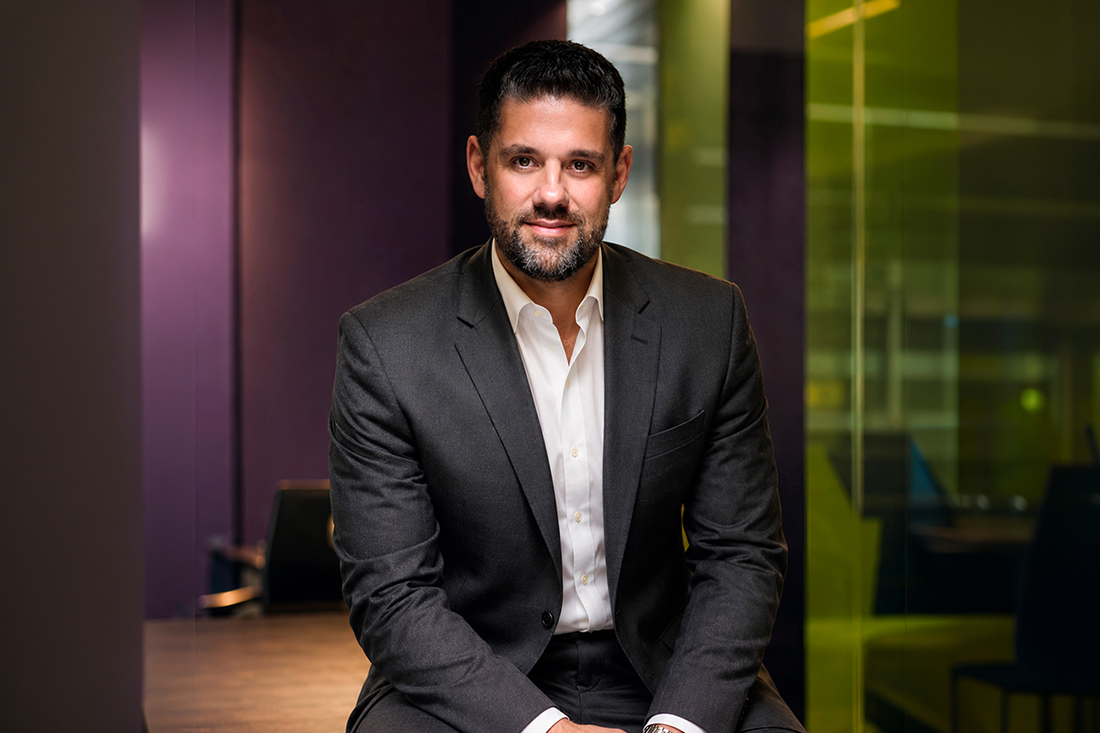
22 Sep Interview with Mr. Ryan Álvarez, CEO of VIVA Bolivia
In a context where connectivity has become a key driver of economic and social development, VIVA Bolivia has played an important role in expanding digital access throughout the country. How do you assess VIVA’s impact on Bolivia’s digital transformation today and what have been the main milestones in this process?
Before we acquired VIVA four years ago, the company had already established itself as a leader in innovation. It was the first company to offer 3G technology and also the first to implement 4G LTE in Bolivia. It had always been at the forefront of driving technological development. However, the previous owners stopped investing in the country and that was when we stepped in. We quickly recognized that the VIVA brand remained very strong among Bolivians, although at the same time most people perceived it as being in decline. We saw that as an opportunity to rebuild the company and strengthen it once again.
I always say this: I had never run a telecommunications company in my life, nor had I even worked for one. My family has always been involved in infrastructure development. We build telecommunications towers throughout Latin America and in other parts of the world. About ten years ago, we had an idea. We realized that the telecommunications industry — not only in Bolivia, but globally — was losing sight of where value and revenue were really being generated. In Latin America especially, average revenue per user is only about three or four dollars, since most customers use prepaid services, meanwhile, the applications and platforms that operate through mobile phones generate billions of dollars. Yet telecommunications companies remained confined to the role of connectivity providers. That is why we decided to transform the company and focus it more on the digital ecosystem than on simple connectivity. This led to the creation of the VIVA APP, a “super app,” one of the first telecommunications-related super apps.
The app allows users to use it as a browser to search for content and access social media platforms. Additionally, it provides access to a marketplace platform and the ability to manage different digital wallets. In essence, it is a complete digital ecosystem that integrates connectivity, commerce, and financial services into a single experience. What we believe is that, through this ecosystem, we can generate new revenue streams for the company beyond connectivity. Within the super app, the experience is based on zero-rating, meaning it is free and unlimited for users. Customers do not have to constantly top up their balance or worry about running out of connectivity. We are currently driving many initiatives within this ecosystem and this has also enabled us to partner with numerous companies. For example, there are integration opportunities with companies such as Alibaba and others involved in e-commerce and digital innovation. Thanks to the ecosystem we have built, we can now afford to offer many of these services free of charge.
Bolivia presents unique geographic challenges that make the deployment of telecommunications infrastructure particularly difficult, especially in rural and hard-to-reach areas. What have been the main technical and logistical challenges in expanding network coverage and how are you addressing them?
We are currently in the middle of a massive investment program that has not yet been completed. We are working with various entities of the United States government, as well as with different technology partners and suppliers. The total investment package will amount to approximately $394 million over the next five years. There are seven or eight different components within this project, so it is quite complex. We expect that by August we will be able to begin announcing many of these initiatives.
For us, the challenge is not so much the construction and infrastructure side, because my family has extensive experience in that field. We have developed and deployed infrastructure in countries all over the world, including jungle regions in Costa Rica. That part does not represent the main challenge for us. The real challenge lies in how to get people to use technology in a way that truly transforms their lives. Today, the vast majority of the use of our super app is related to social media. While social media is powerful and positive, it does not necessarily generate a direct economic impact or help improve people’s circumstances. What we are really focused on is how to encourage people to use social media and digital tools to generate income and become more digitally integrated. Bolivia remains a country that is heavily dependent on cash and the informal economy. My grandfather used to tell a story: when two salespeople first went to Africa and saw that nobody wore shoes, one said, “I’m leaving; nobody wears shoes here.” The other said, “Bring as many shoes as possible; there is a tremendous opportunity here.” That is exactly the opportunity we see.
We know that Bolivia will eventually become digitalized; the question is how to accelerate and facilitate that process. That is why, for us, offering free access is essential. It makes it much easier for people to get connected: they simply need to obtain a SIM card and they automatically begin receiving access, rewards and benefits that they can continue using over time. In addition, we work very actively through the VIVA Foundation, in which I am personally involved. We focus especially on rural communities. We are creating incubators and programs designed to help people in those areas use the internet and digitalization to improve their lives and generate income. We are also working with various universities and educational programs. We have English-language training initiatives and programs aimed at teaching people how to sell online and how to make the most of digital tools. For me, all of this is about combining access with guidance on how to use that access in ways that genuinely improve people’s lives, beyond entertainment or content consumption.
With more than two decades of operations, the telecommunications market in Bolivia has evolved significantly in terms of competition and demand for services. How is VIVA positioned today compared to its competitors and what are the main factors that differentiate its value proposition?
I would say that there is really no other offering in the world exactly like ours. However, in VIVA’s case, we still have a lot of work to do. Before we acquired the company, there had been a great deal of neglect and underinvestment, so our main challenge now is to rebuild the brand and restore consumer trust. That is critical, because we have had to deal with many network issues inherited from previous stages.
That said, my team has done a very solid job. They have managed to optimize very old equipment and there are various reports showing that we currently provide the best streaming service in the market and offer very strong speeds. What we really need to do — and what the $394 million investment is focused on — is expand coverage and increase network capacity. There are areas where we have already reached our capacity limits and we also need to modernize the entire infrastructure. Our goal is to have the entire network ready for both 4G and 5G. The vendors with whom we are in the final stages of negotiation will enable us to build an extremely modern, future-ready network. Even as the industry evolves toward 6G, 7G, or 8G technologies, we will be able to adapt without having to replace the entire infrastructure again. That represents a key advantage for us.
For our competitors to do something similar, they would need to make investments on the same scale. However, they have already invested enormous amounts in their current infrastructures, so it is not realistic for them to replace those systems completely. In our case, we have the opportunity to leave behind equipment that is 15 years old and build, essentially from scratch, a completely new and modern network.
As mobile data consumption and demand for digital services continue to grow globally, how is VIVA adapting its offering — including 4G LTE and digital solutions — to respond to these changes in consumer behavior?
For us, technology itself is simply the means of connection. What really matters is the application and the way we deliver the entire user experience. It is not just about offering something for free. We also have a very strong rewards program. We share a portion of the advertising revenue we generate with our users, which allows them to become much more engaged within the ecosystem.
What we discovered is that, as users begin interacting more with the application, their usage time increases significantly. It has grown from roughly 40 minutes to nearly two hours. Today, users are highly engaged with the platform. They consume news, watch content and participate in a variety of digital activities within the app. The real innovation behind all of this comes from the work of my brother and his software team in Cochabamba. We have developed our own artificial intelligence, specifically designed to understand what each user wants to see and how they want to see it. As people use the application, it continuously adapts to their preferences and behaviors. We call this “hyper-targeting.” After a few months of use, each user’s experience becomes completely unique and personalized, rather than being a generic platform that looks the same for everyone. That level of interaction is key to driving our revenue.
We view the business differently from a traditional telecommunications company. Typically, companies in the sector focus on metrics such as customer churn or average revenue per user. We, on the other hand, look at how much time people spend inside the application, what they do, what content they consume and how they interact with the platform. We are also rethinking the traditional advertising model. Historically, advertising has operated on a “one-size-fits-all” approach, where the ad shown is simply the one from the advertiser willing to pay the most. Instead, we are implementing a “local first” philosophy. We want to support small businesses and small and medium-sized enterprises that historically have never had the opportunity to compete on the same level as large brands. We believe that this is where economic growth is truly driven: when those businesses can showcase their products to people who are genuinely interested in them. That creates a virtuous cycle that benefits users, helps businesses grow and benefits us as well, because we are the ones facilitating that connection.
Our churn rate has been cut nearly in half and that is our strategy. It is at the center of everything we are doing. I would love for us to reach a point within the next five years where we no longer have to charge for the service at all and can offer it completely free of charge. The reason is that the ecosystem will have grown in such a strong and robust way that I will be able to connect anyone for free. To me, that is the future of telecommunications for VIVA.
Home internet access remains a critical factor for digital inclusion, especially in emerging economies. What opportunities do you see in the development of solutions such as VIVA WIFI and how do you expect this segment to evolve in Bolivia?
This segment is clearly growing. Starlink has just entered the market and I recently saw a report indicating that they have already connected around 40,000 households. Up to now, we have focused primarily on the mobile market, but we have also developed partnerships with fiber-optic companies and have already begun rolling out those services. In fact, we plan to expand them significantly.
Home internet access, just like mobile internet, is a key driver of development. I would even say that it probably represents one of the greatest opportunities currently available in Bolivia, because there are still a vast number of households that are not connected. The mobile market, on the other hand, is already close to full saturation. Practically the entire population has one or even two mobile lines. Penetration exceeds 100 percent, so every mobile customer we gain generally comes from another operator. It is not a segment where new users are constantly entering the market. The residential internet sector is different. It is growing very rapidly and forms a central part of the investment program we are developing. We are going to invest heavily in home internet services.
In addition, we are also preparing to relaunch our television service. We had faced some regulatory issues that needed to be resolved, but that situation has now been addressed under the new government, which is something I am genuinely excited about. We expect to relaunch the TV service within the next one or two quarters. One very important aspect is that it will include a free television package, allowing users to access a variety of channels and content at no cost, all integrated within the VIVA APP.
For us, the true foundation of everything we do is the digital service layer and specifically the VIVA APP. That is where all other services and industries connect, because today virtually every industry and every individual interacts through mobile phones. That is why it is so important to build a fully connected digital ecosystem.
Technological innovation — including 5G, artificial intelligence and new digital platforms — promises to further redefine the telecommunications sector. What is VIVA Bolivia’s vision for the coming years and which investments or initiatives will be key to remaining competitive in the Bolivian market? In addition, how can the United States and its technology companies position themselves as strategic partners in this process of innovation and expansion?
One of the major positive changes we have seen under the new government is the removal of many of the barriers that previously limited the sector’s development. I describe it as the fall of a brick wall. Being here and experiencing the process firsthand, I can genuinely say that the change has been enormous. There are now far more opportunities for U.S. companies and international businesses to enter the Bolivian market, establish partnerships, and bring their products and services into the country, helping to drive digital transformation.
One thing I noticed is that Bolivia still lacks many major digital platforms. There is no strong presence from companies such as Mercado Libre, Walmart, Amazon, or Rakuten. Many of these companies had not entered the market before because of the difficulties and restrictions that existed in the past. However, I believe that in the near future these companies will begin to arrive and that will contribute enormously to the country’s digitalization process.
As for 5G, the investment we are making will leave us fully prepared for that technology. However, one of the main obstacles to 5G adoption in Bolivia has been the high cost of mobile devices. Phones were extremely expensive because of existing taxes. I even heard many stories of people traveling to Miami, buying a phone, and returning home because it was cheaper to do that than to purchase the device in Bolivia. Fortunately, the government eliminated those taxes, and devices are now much more affordable. That will be critical for accelerating 5G development, because even if the network is ready, the technology cannot expand if people do not have compatible devices. If we launched 5G today, very few people would be able to use it — perhaps only 5-10 percent of the population would have compatible devices. It will still take time for those phones to reach users on a large scale. In the meantime, we will be ready to activate the network whenever it becomes necessary. What I value most is that the government not only listened to our concerns, but actually took action. That did not happen before. To me, that is a very important sign that there is now genuine collaboration to help grow the industry, rather than viewing private companies simply as large corporations.
Our vision is for Bolivia to be the starting point. We want to test strategies and business models here that have never been implemented anywhere else in the world and then expand them into other Latin American markets using exactly the same approach. That is why we believe this is an extremely exciting moment for the company and for the future of Bolivia’s digital ecosystem.
What is your final message for readers of the Miami Herald and El Nuevo Herald?
I would say, first and foremost, that Bolivia is a great place to visit. There is incredible natural beauty and so many things to see. When we first started looking at the company and my father called me about it, my initial reaction was, “Bolivia?” I know that many people in Miami probably react the same way, thinking, “Bolivia? Really?” But it is an amazing country with wonderful, hardworking people. There are also countless remarkable places to visit, especially natural attractions such as the Salar de Uyuni and Valle de la Luna. There is also Tarija and the entire wine-producing region. You would never expect Bolivian wine, but honestly, it is some of the best wine I have ever tasted.
The beef industry is excellent as well — the cuts of meat, the restaurants, the overall culinary scene are all incredibly vibrant. So my first recommendation would be to come and experience Bolivia in person, to see it with your own eyes. From there, we can continue strengthening and expanding the relationship between Bolivia and the U.S.
Sorry, the comment form is closed at this time.